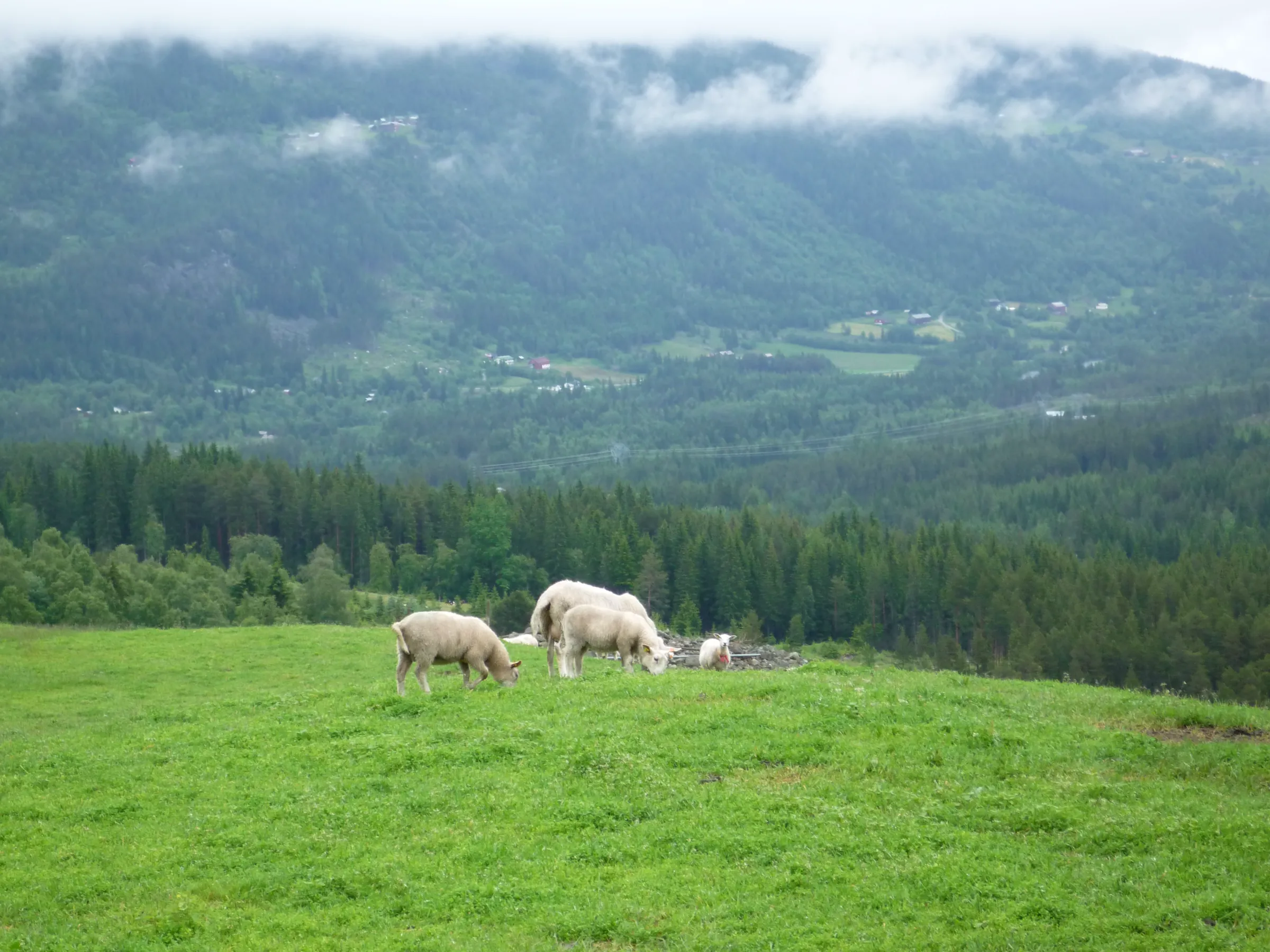
There are photographs of Norway everyone has already seen a thousand times: a sheer cliff, a narrow fjord, a drone shot somewhere above the water. And then there’s what rarely makes it into the brochures — sheep grazing on a mountain slope while the morning fog still sits in the valley below. Not staged, not arranged for the camera — just an ordinary July morning on a pasture that was here long before any traveller, and will be here long after.
That difference — between looking at a fjord and living alongside one for a while — is really what Norwegian summer is about.
Water That Isn’t in a Hurry
In summer, a fjord barely moves. On a still day, the water turns flat enough to mirror the mountains around it — flat enough that it’s genuinely hard to tell where the slope ends and its reflection begins. That’s not a figure of speech; it’s optics — the angle of the surrounding hills, the water temperature, and the stillness of the season combine in a way winter almost never allows.
Nothing needs to be organised around it. A ferry passes waterfalls still full from the spring melt, a wooden jetty creaks underfoot, and the only real decision of the day is whether to open the veranda door or step outside entirely.
A Slower Pace, Built Into the Route Itself
Many Norway itineraries are built as a list of stops: a trail, a viewpoint, another trail. A well-considered summer route through the fjords works differently — it leaves space between the stops on purpose, because that space is usually where the actual point of the trip happens: sitting on a veranda with a view of the water and doing nothing in particular for an hour, or an evening.
That’s not the same as having nothing to show. It means the route trusts the place — rather than filling every hour with something to see, it leaves enough time for what’s already there to settle in.
Oslo First, Then the Quiet
A couple of days in Oslo before the fjords works less like a city programme and more like a transition — the city offers context: history, people, the rhythm of the country — before that rhythm slows down considerably. Without that contrast, the fjords can feel like a beautiful but abstract backdrop. With it, the quiet that follows makes a lot more sense.
Every fjord route we put together is different — shaped around the season, the pace a guest actually wants, and which parts of the coast are quiet at that particular time of year.
Begin the Conversation | Explore Journey Design | See Example Journeys